

Practise for Kubernetes and Linux certifications on real infrastructure
KCNA, KCSA, CKA, CKAD, CKS, LPIC-1 and LPIC-2: one path per certification, split into modules that follow the exam’s domains. Every step runs on a real cluster or a real Linux machine and is graded on its state, then practice exams put you in exam conditions before the day. More paths are on the way.
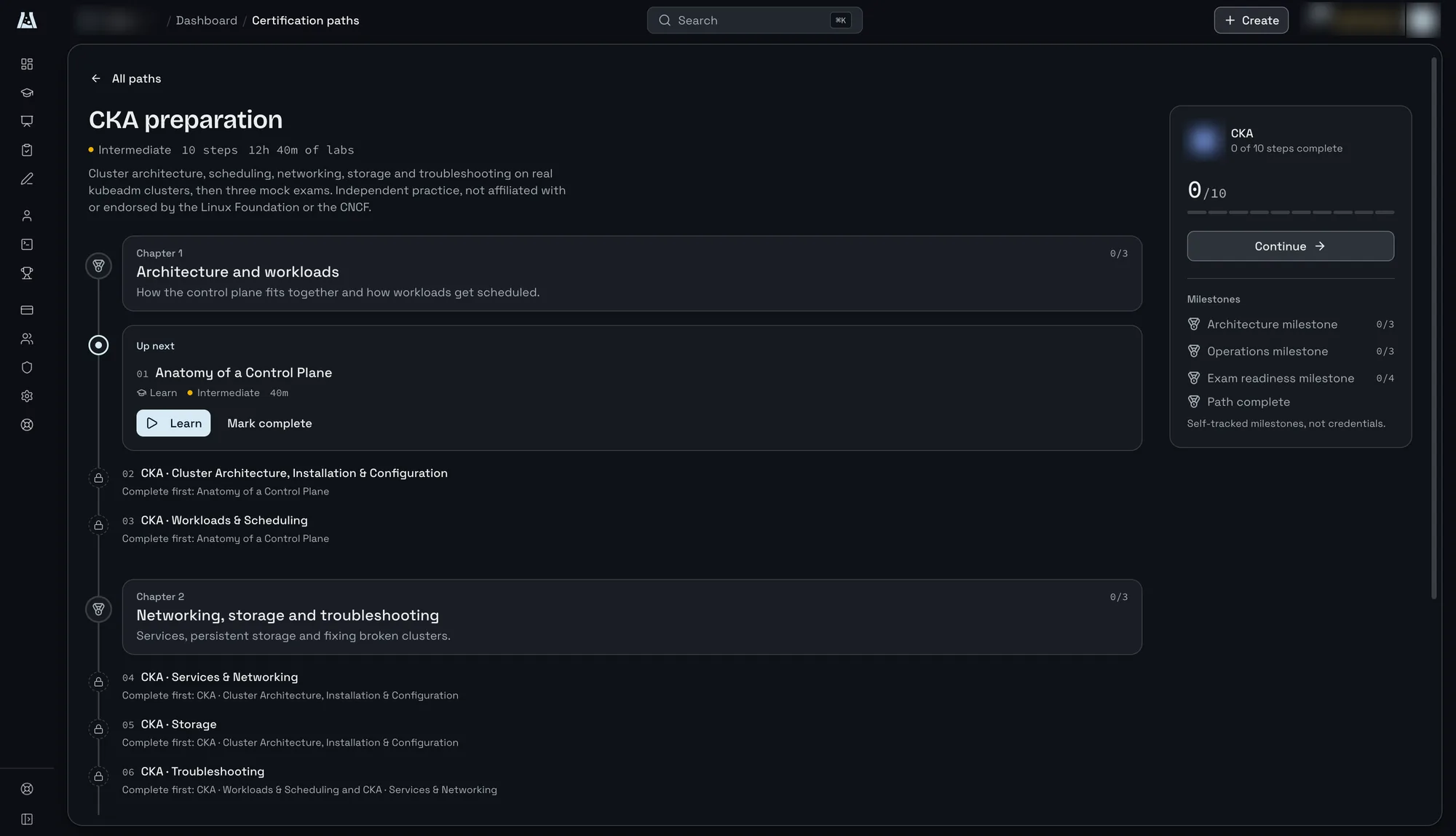
One path per certification, Kubernetes and Linux
Seven paths today: five for the Linux Foundation’s Kubernetes certifications, two for LPIC. Each follows its certification’s domains, module by module, and ends with one or more practice exams.
KCNA
Cloud native fundamentals in two modules: what a cluster is made of and how workloads run on it, then configuring, exposing, shipping and observing applications.
KCSA
Kubernetes and cloud native security: the security model and the threats a cluster faces, then component and platform security, and compliance.
CKA
Three modules on real kubeadm clusters: architecture and workloads (control plane anatomy, cluster installation and configuration, scheduling), then networking, storage and troubleshooting, then exam readiness.
CKAD
Build and configure applications (workloads, configuration, secrets, access control), then deploy, expose and observe them: rollouts, services, networking, observability and debugging.
CKS
Harden the cluster and the system beneath it, then secure workloads and the supply chain: microservice vulnerabilities, supply chain, runtime threat detection. On real kubeadm clusters.
LPIC-1
System administration on a real Linux machine: architecture, installation, packages and the shell, then devices, filesystems and scripting, then essential services, networking and security.
LPIC-2
Advanced Linux administration: capacity, kernel, startup, filesystems, RAID and LVM, then DNS, web, file sharing and email, then security, DHCP, PAM and LDAP.
More paths are coming. The catalogue keeps growing. New certification paths are in the works and appear here as soon as they ship.
The Kubernetes paths run on real clusters, the LPIC paths on a real Linux machine. Either way, grading reads the system’s actual state, not the commands you typed.
How a path works
You go at your own pace, and your progress is saved for you.
- 01
One module per domain
Steps are grouped by exam domain. Each one shows its level and a suggested duration.
- 02
Steps that unlock
Each step says what to finish first. The mock exams come after the modules that prepare them, so you reach them with the basics in place.
- 03
Graded on the cluster’s state
Validation rules read what you actually changed. A failed task tells you what is missing from the cluster, not just that the answer was wrong.
- 04
Milestones, not diplomas
Each finished module unlocks a milestone. They are markers you declare yourself, not certifications.
Why practise on kubeadm rather than minikube or kind?
Because the CKA and CKS ask you to work inside the cluster. Minikube and kind are great for development, but they hide what you need to handle. On Klastro you are root on real kubeadm nodes, each on its own microVM with its own kernel, and the cluster disappears when the session ends.
So you can break a control plane, stop a kubelet or botch a join without damaging anything: the next session starts from a fresh cluster.
What you actually handle
- The control plane’s static Pods
- etcd, the control plane’s datastore
- The kubelet and its configuration
- The cluster’s certificates
- A worker join, and a node to drain
Klastro and killer.sh: before, and between sessions
Klastro does not replace the simulator that comes with the exam. Registration includes killer.sh sessions, best kept for the dress rehearsal. Klastro is for before and between those sessions: learning domain by domain, retrying a challenge until you pass it, and taking mock exams graded on the state of the cluster.
A four-stage preparation plan
- Work through the modules in order, without skipping prerequisites
- Retry the challenges where you lose points
- Take the three mock exams in one sitting, timed
- Keep killer.sh for the very end
How do you prepare for LPIC-1 and LPIC-2?
On a real Linux machine, opened in the browser and destroyed at the end of the session. You install packages, mount filesystems, configure services and networking, and grading checks the state of the system rather than the commands you typed. Each level ends with two practice exams.
What the two paths cover
- Packages, the shell and scripting
- Devices and filesystems
- Kernel, startup, RAID and LVM
- DNS, web, file sharing and email
- Security, DHCP, PAM and LDAP
Frequently asked questions
-
Which certifications can you prepare for on Klastro?
- Seven today: the Linux Foundation’s KCNA, KCSA, CKA, CKAD and CKS, and the Linux Professional Institute’s LPIC-1 and LPIC-2. More paths are in the works and join the catalogue as soon as they ship.
-
Is Klastro an official Linux Foundation simulator?
- No. Klastro is an independent practice platform, not affiliated with or endorsed by the Linux Foundation, the CNCF or the Linux Professional Institute. The mock exams are practice exercises on each certification’s domains, not a copy of the exam.
-
Do I need the CKA to sit the CKS?
- Yes, you need to have passed the CKA to sit the CKS. So the CKS path assumes you can already administer a cluster, and concentrates on securing it.
-
Can I retry a step or a mock exam?
- Yes. Challenges keep your attempt history, and every session starts from a fresh cluster. Retaking a mock exam after reworking a module is the best way to measure your progress.
-
Do I need to install anything?
- No. The terminal, the editor and the instructions open in the browser, and every step starts its own cluster in seconds. During the public preview, sign-up is by invitation.
-
Can I prepare for a certification with my team?
- Yes. A trainer or a training centre can build a track from catalogue scenarios, including those in the certification paths, then open it to a cohort they follow live.
-
Are milestones worth a certification?
- No. Milestones mark your progress through the path, and you declare them yourself. Only the official exam awards the certification.
CKA, CKAD, CKS, KCNA and KCSA are trademarks of the Linux Foundation; LPIC is a trademark of the Linux Professional Institute. Klastro is not affiliated with or endorsed by either organization. Certification logos belong to their owners and only identify the certification a path prepares for.
Start your preparation
Klastro is in public preview. Request an invitation and tell us which certification you are preparing for.